Therefore all seasons shall be sweet to thee,
Whether summer clothe the general earth
With greeness, or the redbreast sit and sing
Betwixt the tufts of snow on the bare branch
Of mossy apple-tree, while the nigh thatch
Smokes in the sun-thaw; whether the eave-drops fall
Heard only in the trances of the blast,
Or if the secret ministry of frost
Shall hang them up in silent icicles,
Quietly shining to the quiet Moon.


Monday, May 30, 2011

Close Encounters of the Elephant Kind


We are back in Africa now as I still have a couple of posts to do about my visit there earlier this year. For Steve and Hannah it was still term time and although they took some leave there were a couple of days when Juliette and I had to amuse ourselves. On one of these days we went to Elelphant Whispers.


There are six elephants living here and all have been rescued from planned culling operations at various game reserves and now spend their time as 'elephant ambassadors'. They are used to teach visitors about elephants and to allow close interaction with these magnificent animals. All are young elephants the oldest being Tembo who is 27 years old. The four in the above photo are Medwa, Andile, Shamwari and Ziziphus.


Andile has been asked to lie down so that we can go up and really look at her closely. She is a young elephant still in her teens.


A good portion of an elephant's foot is composed of fibrous fatty tissue which acts as a shock absorber. It's like an elastic spongy cushion which helps the elephant maintain its grip on the ground and also allows it to move silently. When I pushed on the sole of Andile's foot I could feel it give quite substantially. You can see the huge toe nails here as well but these aren't actually attached to the toes and there are only four toenails whereas there are five toes buried deep inside the foot.


I found this illustration which shows the inside of the foot which doesn't look the way you'd expect. The elephant essentially walks on tiptoe!


Andile is showing us her teeth and tongue in this photo. Clicking on it will give you a better view. Her tongue feels like smooth satin when you touch it. An elephant has six sets of molars during its lifetime and as a tooth wears out from the constant grinding another one pushes forward to replace it. The worn down teeth wear off onto a shelf which eventually breaks off and falls out.The final set of molars appear when an elephant is about 30 years old and last until around the age of 65.  As the final molar breaks down it becomes increasingly difficult for the elephant to break down and digest food and the main cause of death in mature elephants isn't old age but starvation.


The thick, wrinkled skin helps elephants stay cool because water gets trapped inside the wrinkles and evaporates slowly thus cooling the elephant. And just look at those eyelashes!


Elephant's use their ears to help regulate their body temperature. The back of the ear has a huge network of veins and capillaries and the hot blood from the arteries is cooled as it filters through them before returning to the body.  They are used for signalling too - if you see an elephant with its ears spread wide it means it sees you as a potential threat!


Time for Tembo to take centre stage now as we take it in turns to stand between his front legs to have our photograph taken with him. I'm actually leaning against him and feeling extremely small!  Those magnificent ivory tusks are used to dig for water, salt or roots, for debarking trees and on occasion for fighting.


There was only one young couple there at the same time as us and they had only booked to do the interaction. Juliette and I had also booked to go for a ride and there were just the two of us for this part of session. We were lucky as the previous day had been very busy and we wouldn't have had quite as much time with the elephants when a large group were there. I was riding Lindiwe as she is the smallest elephant and as I have back problems I was told that the smaller elephant was a wiser choice.


Riding an elephant is an odd feeling to begin with, like camels they get up front feet first but the motion is different once they start to walk - I've ridden both horses and camels and it isn't like either. Apparently some people get motion sickness and we were told to tell our handler if necessary as there is an emergency stop command for the elephants!


Happily Juliette and I were fine and once I had adjusted to the rhythm I felt I could have gone on all day. Although only two elephants were being ridden all of them came on the walk presumably because they like to move as a herd.


Here I am saying 'thank you for a lovely ride' to Lindiwe, she is very keen to accept the treats I'm offering:) Her trunk is incredibly sensitive and can pick up something as small as a blade of grass. It's used for smelling, drinking, feeding and as an exploratory organ rather as we would use our fingers. It also gets used as a snorkel when they are swimming.
It was a really wonderful experience, being so close to these magnificent creatures and spending time with them was a real privilege and something I shall never forget.

Sunday, May 15, 2011

The Tudors Again!


Last Saturday I had the pleasure of meeting up with Diane of Heart Shaped and Rosie of Corners Of My Mind at Haddon Hall. I hadn't intended doing a post about it as I still had the Tudor Revels post and at least a couple more from my Africa trip to do. On reflection though I decided I would write a little about it as I had such a lovely time with them (in spite of the rain!). Both have written much more extensively and with many more photos than I'm doing so do go and visit their blogs.
The photo above shows the fabulous topiary in the Gardener's Cottage which lies at the foot of the slope that leads up to the Hall itself. The Boar's Head and the Peacock are emblems of the Manners family who have owned Haddon Hall since the mid 16th century. Haddon itself dates back to the 12th century though and is one of the best kept secrets of the Derbyshire Peak District.


The reason for our visit was to see the Tudor Re-enactment that was taking place over the weekend. As we climbed up towards the Hall we met these Tudor youngsters on their way down.


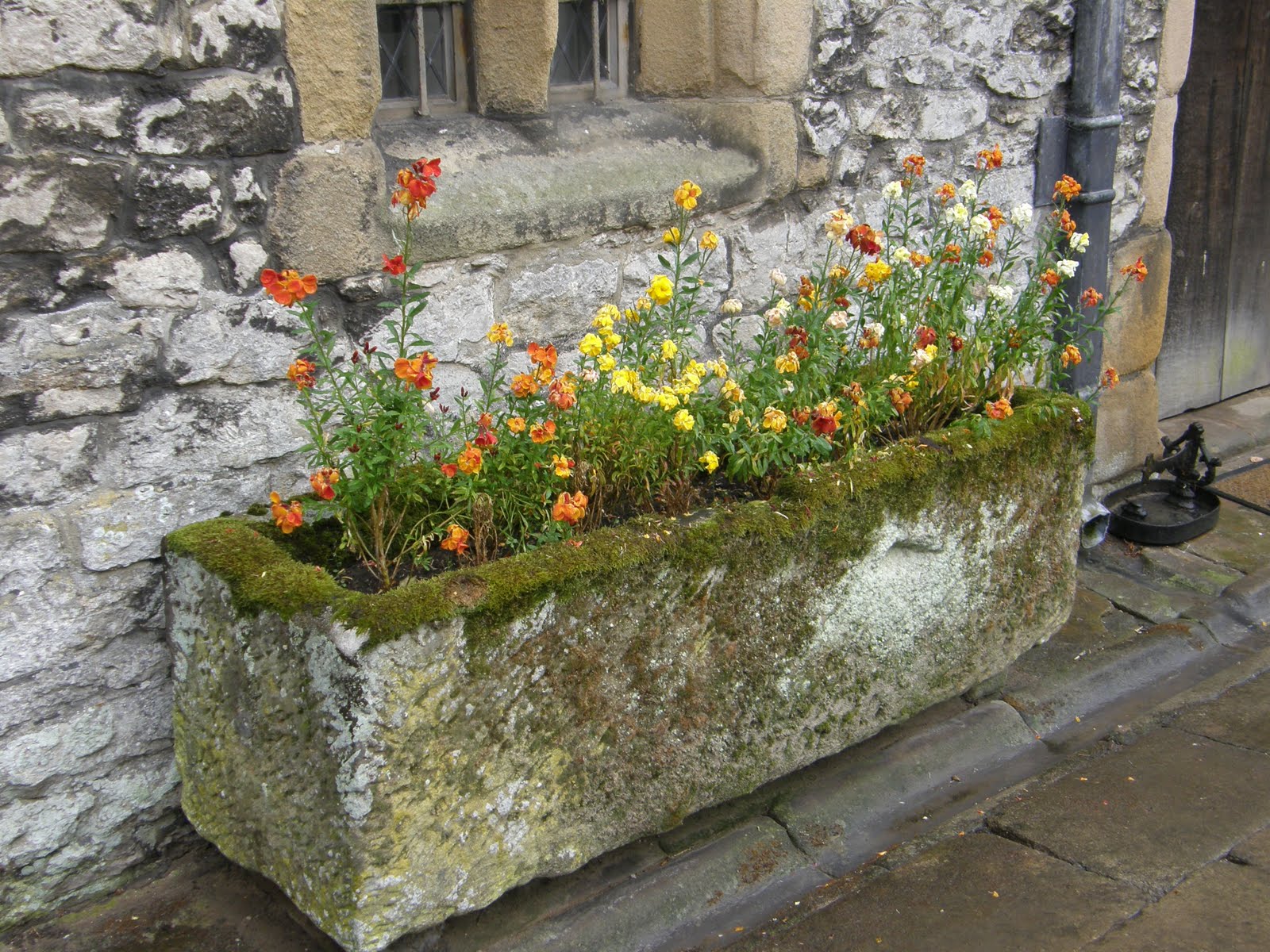
I couldn't resist putting in this photo of the old stone trough planted up with wallflowers even though I know Diane and Rosie have both used it in their posts. It made such a lovely splash of colour on what was a decidedly grey day.


Gathering herbs to be used in some of the dishes being prepared for the Lord of the Manor and his guests.


In the Great Hall the menservants are receiving instructions on the correct way of approaching the Lord of the Manor's table when they are serving the meal. There was a very strict and formal way of doing this in Tudor times. I've visited Haddon many times but this was the first time I've seen a fire burning in the great hearth and it made such a difference to the room.


Pastry being prepared for one of the many elaborate pies that would form part of the meal. I have a green glazed bowl exactly like the one on the table but I confess that I've never made pastry or anything else in it in case it gets chipped!


Haddon has the most wonderful medieval kitchens and it's fantastic to see them being put to use again. The young man has the fiddly task of removing half the shell of these quail eggs so that they can appear at table looking as though they are whole!


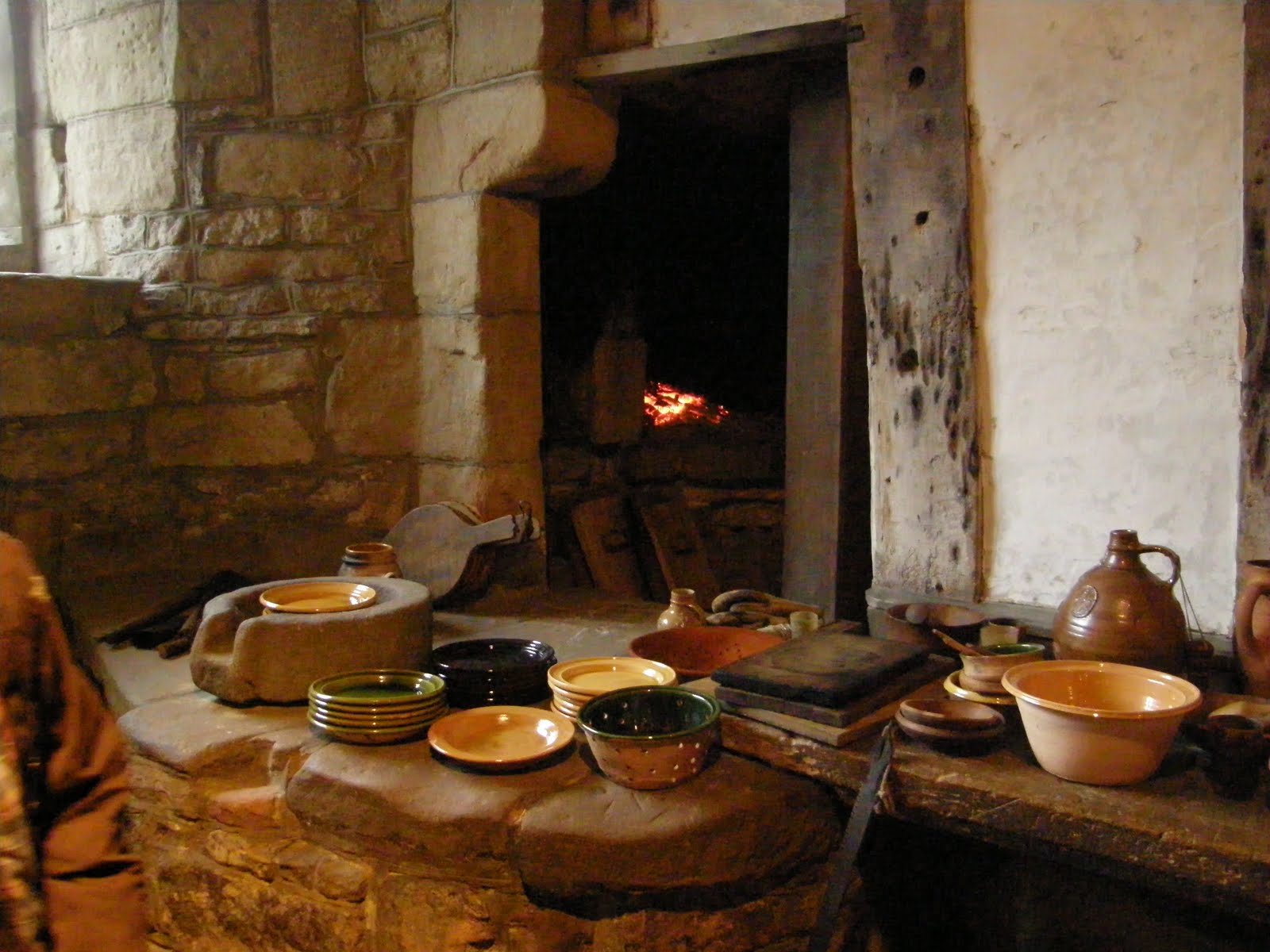
Just look at all these wonderful bowls and jugs and jars - I can't tell you how much pleasure it gives me just to look at them.


More of the dishes and flagons and in the background you can see one of the bread ovens which has been fired and used to bake bread and pastries.


Again Rosie and Diane both  featured these lovely arrangements that were in may of the rooms of the Hall, they are so simple - sprays of beech and hedge parsley in a plain glass container but they look stunning. All three of us loved them.


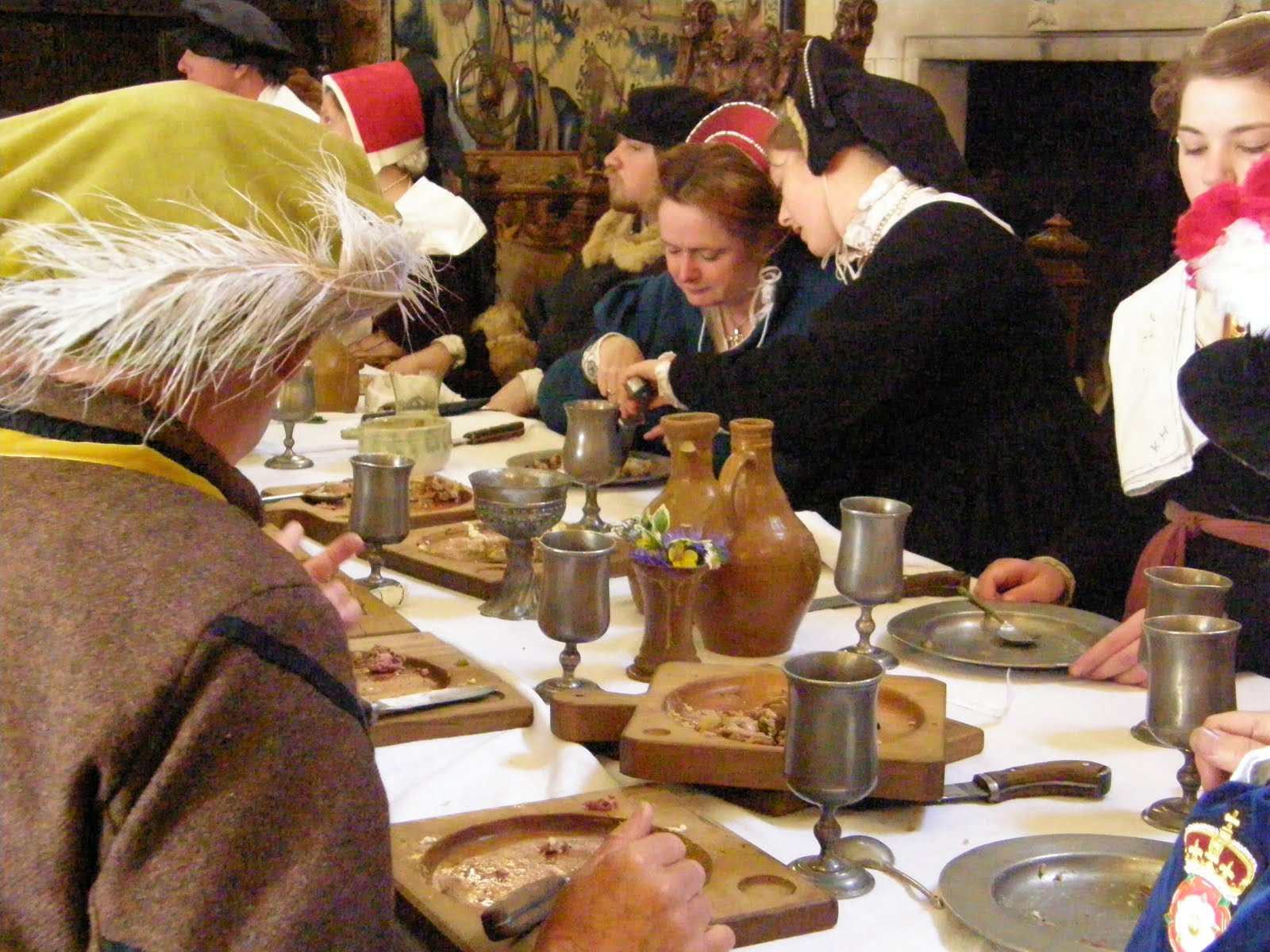
The upper servants  dine before the Lord of the Manor and his family and guests. I was surprised to learn that' the family's priest was counted as an upper servant but apparently this was the case.  These servants eat  well though not the elaborate kind of meals that are served to their master. The lower ranks of the servant class certainly wouldn't be eating the beef and cheese that appear on this table, a bowl of pottage and a hunk of bread would have been about it. Sadly at this point I had to leave as my husband was away and a certain dog was waiting for me to take him out for his afternoon walk - a very late afternoon walk by the time I got home poor lad.  It was such fun seeing it all with Diane and Rosie and hopefully we will have another joint outing at some point.  

Tuesday, May 10, 2011

Tudor Revels


This is a rather belated post about May Day, I was staying with my son and his family in Suffolk and on the Sunday we went to the Tudor Re-enactment at Kentwell Hall. Kentwell is an Elizabethan manor house which was built in the late 16th Century by the Cloptons, a wealthy local gentry family.


Kentwell is a moated manor house. Originally built as a first line of defence the moats gradually became ornamental rather than practical.


In the kitchen servants were busy preparing the midday meal.


I really love all the  baskets and pottery from this period, I have quite a few replica bowls and jugs in my kitchen and would like more of them too:)


The lord of the manor and his guests at their midday meal.I thought this was interesting as it shows details of the clothes and also you can see that only the head of the household sat on a proper chair. The other guests and members of the household are sitting on wooden benches.


People are eating off either pewter plates or wooden trenchers and the utensils consist of only a knife and a spoon.It was perfectly acceptable, even in the most aristocratic circles, to use your fingers to pick up and eat many items of food.They are probably drinking ale as most water was polluted and dangerous to drink. Even children would drink 'small beer' which had a very low alcohol content.


Meanwhile these young girls were making May garlands weaving wildflowers and sprigs of willow or honeysuckle onto a circle made of willow withies. They are so pretty that I'm going to have a go myself next year as it's only the same priciple as I use to make my wreaths at Yule.


The procession of villagers going towards the Hall to begin the day's revelries. The man dressed in the colourful costume made of rags is the Master of Ceremonies who will  be taking part in the Mummer's play.


St George being despatched by Saladin! Of course being a Mummer's play St George is eventually restored to life in a very dramatic fashion by the Quack Doctor and lives to fight the Dragon another day:)


After the excitement of the play the gentry can relax and enjoy a quiet chat....


.

.....while the villagers look forward to the next part of the May Day celebrations as they return to the Village Green.


The high spot of May Day is the raising of the Maypole, a young tree gaily decorated with coloured ribbons.


The village band strikes up and......


.....the revels begin.


A certain young man has his first archery lesson. Through his grandmother (me!) the blood of Cheshire bowmen runs in his veins - they were reknowned as the finest archers of medieval England.


Earlier we had George and the Dragon, here we have George and the peacock:)


A quiet moment at the end of a wonderful day.

Friday, April 29, 2011

Queen of the May


You must wake and call me early, call me early, mother dear;
To-morrow ’ill be the happiest time of all the glad New-year;
Of all the glad New-year, mother, the maddest merriest day,
For I’m to be Queen o’ the May, mother, I’m to be Queen o’ the May.

There’s many a black, black eye, they say, but none so bright as mine;
There’s Margaret and Mary, there’s Kate and Caroline;
But none so fair as little Alice in all the land they say,
So I’m to be Queen o’ the May, mother, I’m to be Queen o’ the May.


I sleep so sound all night, mother, that I shall never wake,
If you do not call me loud when the day begins to break;
But I must gather knots of flowers, and buds and garlands gay,
For I’m to be Queen o’ the May, mother, I’m to be Queen o’ the May.

The honeysuckle round the porch has woven its wavy bowers,
And by the meadow-trenches blow the faint sweet cuckoo-flowers;


And the wild marsh-marigold shines like fire in swamps and hollows gray,
And I’m to be Queen o’ the May, mother, I’m to be Queen o’ the May.

The night-winds come and go, mother, upon the meadow-grass,
And the happy stars above them seem to brighten as they pass;
There will not be a drop of rain the whole of the livelong day,
And I’m to be Queen o’ the May, mother, I’m to be Queen o’ the May.


All the valley, mother, ’ill be fresh and green and still,
And the cowslip and the crowfoot are over all the hill,
And the rivulet in the flowery dale ’ill merrily glance and play,
For I’m to be Queen o’ the May, mother, I’m to be Queen o’ the May.

So you must wake and call me early, call me early, mother dear,
To-morrow ’ill be the happiest time of all the glad New-year;
To-morrow ’ill be of all the year the maddest merriest day,
For I’m to be Queen o’ the May, mother, I’m to be Queen o’ the May.

Alfred Lord Tennyson

The painting at the top of this post is called 'Queen Guinevere's Maying' by an artist called John Collier.
I shall be away visiting my son and daughter-in-law in their new home in Norfolk for a few days and hopefully going to a Tudor Living History Day at Kentwell Hall on May Day. This is one of the lovliest times of the year now filled with all the wonderful fresh new leaves and flowers of early summer.

The wonder of the world,
the beauty and the power,
the shapes of things,
their colours,lights, and shades;
these I saw.
Look ye also while life lasts.

I wish all of you a very Happy Beltane.

Monday, April 18, 2011

Kruger


I'm finally back again with another post about my trip to South Africa. There is so much to do in the garden at this time of year and in the UK you can never be sure how long the good weather will last so I tend to make the most of it while it's here! The forecast for the rest of this week is good though so I'm going to get this done before going out for another gardening session.
We had two visits to Kruger National Park but neither was especially great as it's the wrong time of year, the grass is very long after the summer rains and it's hard to spot the animals even when they are fairly close by. We didn't see any of the big cats at all sadly but the animals we did see we got pretty close to, the photos are a selection from both days. Above is a huge bull elephant who was right by the side of the road. He made it clear that he intended crossing and that we were in his way so Steve reversed a short distance to let him pass.


This isn't a great photo but I put it in to show just how much it was raining and just how close we were to the elephant.


There is a lot to see besides the big animals, there are many beautiful birds for instance. This is a European Roller and you can see from the sky in the background that we weren't having the greatest of weather!


This photo was taken by my daughter as most of the good sightings we had were on the side of the car where she and Steve were sitting so I found it hard to get good shots a lot of the time. This is Juliette's favourite animal - a warthog. I must admit that I rather like them too.


Steve is very good at spotting small things at the side of the road, while we are all shouting 'elephant, elephant' he's busy shouting 'chameleon' or 'dung beetle'!
This smartly dressed chap strutting along the side of the road is a chameleon of course. It's worth enlarging the phot so that you can see his face and the beautiful markings more clearly.


We didn't actually see any dung beetles this trip so I am cheating and putting in this photo taken when I was there in 2004. They are amazing little creatures and I can still remember watching as he staggered across the road pushing something that was 3 or 4 times his size.


One thing we did see a lot of was baboons invariably in big family groups. This one was sitting by the roadside peacefully enjoying what looks remarkably like an apple.


Baby baboons are very cute indeed.


This is the nearest you are going to get to seeing a leopard in this post! A leopard tortoise pottering along the road. It's actually very interesting to see this kind of thing. I suspect that a great many people are so busy looking for lions and elephants that they miss the smaller and often equally interesting creatures.


If you enlarge this you will see impala in the background. There were actually four giraffes but they were never close enough together to get them all in one shot. We saw quite a lot of giraffe but they were surprisingly hard to spot among all the trees and undergrowth.


The Southern Ground Hornbill is the largest of the hornbills and is increasingly rare. They are mostly only seen within game reserves now and they are not all that common even in a protected environment so we were lucky to see them and especially as close as this. They were within a few feet of the car and I was the one who spotted them:):)


The hippo and two buffalo were on the other side of a fairly wide river but fortunately we had binoculars with us so were able to get a good view of them.


I've cropped one of my photos of the hippo so that you can see him better.


Same hippo but he's trundled along into the river now.


This handsome bird is a saddle-billed stork. They are huge birds and the males can be up to 5 feet tall with a 9ft wing span.


We were fortunate to get a really good view of this herd of zebra, you don't see zebra anything like as often as you'd think.


Another of Juliette's photos, the baby elephant was on her side and my view was also blocked by an excited Kaitlyn leaning across in front of me:)


It was the end of the second day and we were heading towards Phabeni gate when we saw what was the best sighting of all as far as I'm concerned. This female spotted hyena was laid by the side of the road suckling her cub. I never expected to get as close as this to a hyena.


She raised her head to look at us as we sat watching but gave no sign of being afraid or moving.Hyenas have a poor public image but after seeing this they have taken their place among my favourite animals.In fact they are not primarily scavengers but are very efficient hunters who will successfully tackle prey as large as buffalo. They are highly intelligent animals too.


We did actually see a rhino and various types of antelope - waterbuck and kudu among them but they were too far away or too invisible among the grasses for good photos. Here, for instance, we have my rhino photograph! Not a candidate for wildlife photograph of nthe year I think you'll agree:) It does show how hard it was to see things though.
So there you have it, not all that exciting really but one or two moments worth waiting for. Other people's Africa blogs will show you lions, leopards and cheetah, with me you get chameleons and dung beetles! At least it's a bit different though:)