Therefore all seasons shall be sweet to thee,
Whether summer clothe the general earth
With greeness, or the redbreast sit and sing
Betwixt the tufts of snow on the bare branch
Of mossy apple-tree, while the nigh thatch
Smokes in the sun-thaw; whether the eave-drops fall
Heard only in the trances of the blast,
Or if the secret ministry of frost
Shall hang them up in silent icicles,
Quietly shining to the quiet Moon.


Wednesday, September 02, 2015

Cider With Rosie


By the time we arrived in Painswick the sun was finally shining for the first time since we left home.I haven't been to Painswick for several years and it struck me as being much quieter with fewer shops than on my previous visit. Certainly we had no problem finding a space in the car park. St Mary's church is renowned for its yew trees - ninety nine of them were planted in the early 18th century and there was a legend that if a hundredth one was planted then the Devil would pull it out. I gather that there are now one hundred and three so draw your own conclusions:) The churchyard is also famous for its many table tombs belonging to the clothiers and merchants of the area who became wealthy as a result of the thriving Cotswold wool trade. In the 15th century when the Lord Chancellor's seat was created in the House of Lords it was made of Cotswold wool and became known as the Woolsack and the name continues to the present day. 


The 15th century nave of St Mary's. The original Norman church is mentioned in the Domesday book but nothing is left of it now.


The north aisle which you can just see on the left of the previous photo was built in the reign of Richard II who was king from 1377-1399 and on two of the stone corbels are carved heads of Richard (above) and his Queen Anne of Bohemia.


My favourite thing in this church was the wonderful model of the 'Bonaventure' the flagship of Sir Francis Drake when he saw off the attempted invasion of England by the Spanish Armada in 1588. I believe that it replaces a much older model which was badly damaged during the Civil War when Royalist soldiers threw hand grenades through the church windows to drive out the Roundhead soldiers who were sheltering inside.


In 1643 a Puritan soldier passed his time while imprisoned in the church by carving this graffiti on one of the stone pillars in the nave! It included a rough quote from Edmund Spenser's 'Faerie Queene' - Be Bold, Be Bold, But Not To Bold. The spelling mistake is his not mine:)


By this time it was early afternoon and we were hungry so we looked for somewhere to have a spot of lunch, Juliette spotted a little cafe called 'The Patchwork Mouse' so we went in there and had an excellent toasted sandwich and a cake. Afterwards we had a stroll round Painswick but I don't seem to have taken any photographs for some reason. I don't know why as there were a lot of lovely Cotswold stone houses and cottages. Before we left I wanted to go and see if we could find Tibby's Well which was down a long and very steep lane. It was once the main source of drinking water for the village and is rather attractive. The climb back up the lane was just the thing to work off lunch!


Not far from Painswick is the village of Slad. We wanted to see the place made famous by Laurie Lee's book 'Cider With Rosie'. It tells of his childhood in a remote Cotswold village in the early years of the 20th century - he was born in 1914 and came to Slad at the age of three. Although he eventually left the village at the age of 19 he returned to Slad in his later years and is buried in the churchyard more less opposite the Woolpack Inn where he apparently spent a lot of his time! The inscription at the bottom of the headstone reads 'He lies in the valley he loved'. Incidentally the name of the village comes from the Old English word 'slaed' which means a damp valley - it's well named I think.


I didn't immediately realise that there was more on the reverse side of the headstone - these lyrical words come from his poem 'April Rise'

 If ever I saw blessing in the air
 I see it now in this still early day
 Where lemon-green the vaporous morning drips
 Wet sunlight on the powder of my eye.


This is the memorial window to Laurie Lee in the church, it isn't a very good photo but it was the best I could manage. The church was very dark and there was quite strong light outside. It's a shame as it's a very attractive window. The violin is in one of the panels because as well as being a poet and writer he was a talented fiddle player and he earned money in both London and Spain by playing his violin after leaving home in 1934.


The 16th century Woolpack Inn which is still an unspoilt country pub, it's a pity we didn't arrive in Slad a bit earlier because we could have had some lunch here. Apparently the food is very good. We didn't go inside but I wish now that we had. Laurie Lee lived very near to the Woolpack and spent a lot of time in here:)


The Old School House is across the road from the Woolpack and this is where Laurie went to school in his early years before moving on to Central Boy's School in Stroud when he was twelve years old. It's a private house now of course, so many of the old village schools no longer exist. I would really like to go back and spend several hours in Slad as there is what looks like a lovely and interesting four mile walk around the area which is still idyllic. By now it was quite late in the afternoon and we needed to start heading back to Evesham but instead of taking the main road we went across country along narrow winding lanes that went on for miles and were literally just the width of our car. I don't know what would have happened if we'd met something coming the other way as passing places were pretty much non existent.


Eventually we came to the attractive little village of Duntisbourne Abbots with its simple but beautiful 12th century church. I had a particular reason for wanting to stop here.


We had with us an old guide book to the Cotswolds and in a small paragraph about Duntisbourne Abbots it said that in 1875 the villagers had disturbed the neolithic Jack Barrow when ploughing and had reinterred the bones they found in the churchyard. They marked the spot with a cross made from stone of the original barrow megaliths. It didn't say where the grave was but I found it quite quickly by just looking round for stone that looked different from the rest of the gravestones in the churchyard.


Proof that I'd found the right grave from the  worn but still fairly legible inscription.


Much of the original Norman church is still there in spite of some restoration in Victorian times. I should perhaps say here that my daughter's enthusiasm for visiting churches is very minimal indeed and my interest in them is purely because in general that is where the history of most places is to be found. She is kind enough to indulge me in this:)


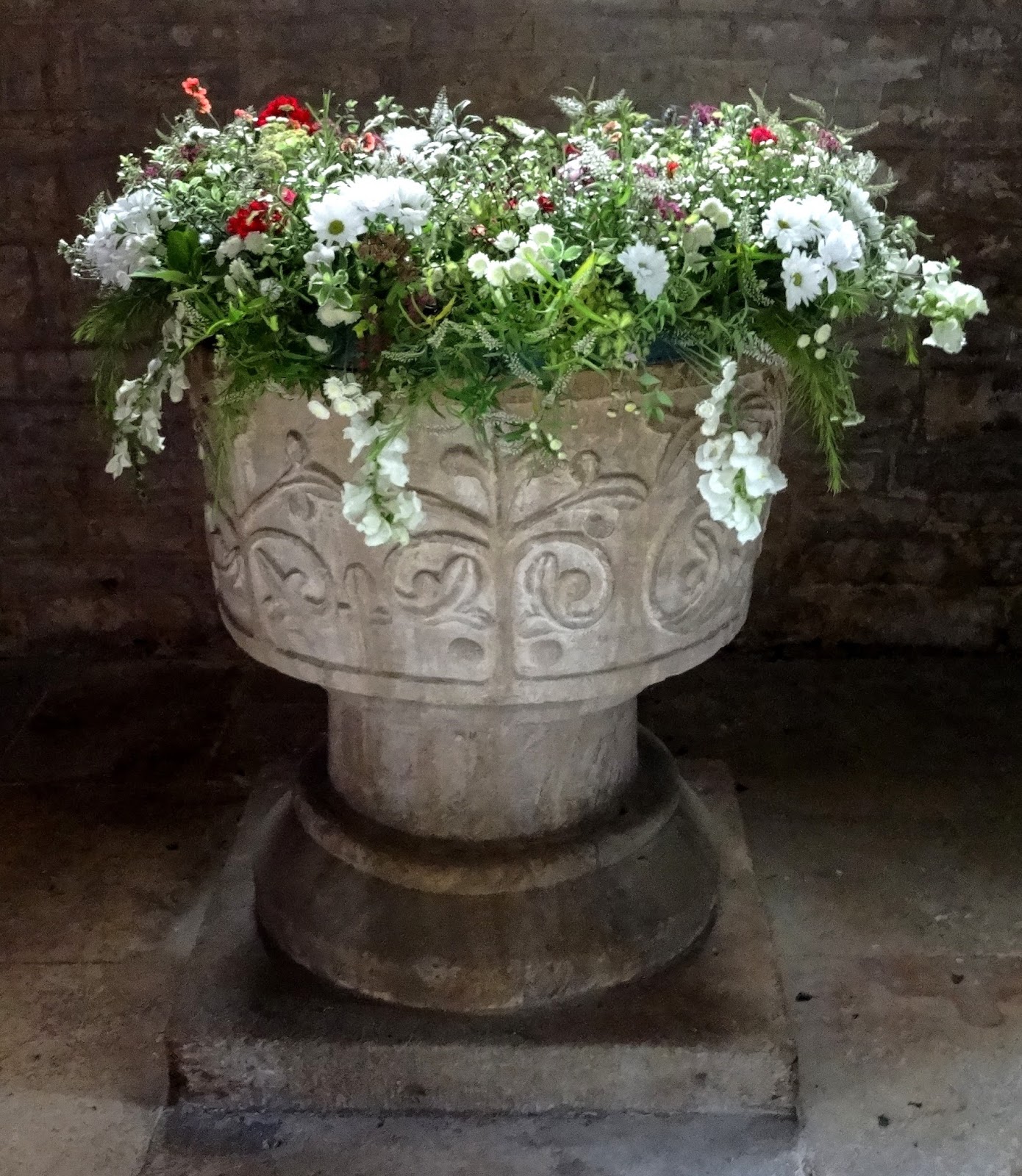
The final photograph is of the late Norman font beautifully decorated with flowers. We think that there might have been a recent wedding and that was why the flowers were there. This font must have been here for nearly 900 years. There are so many lovely places  in the Cotswolds to visit or revisit. I feel sure we shall be returning for a few more days next year.

Sunday, August 30, 2015

Belas Knapp


Our main objective on the third day of our trip was to visit the neolithic longbarrow of Belas Knapp but on the way we passed through Winchcombe where we stopped for a quick look round. The photo above shows a 15th century merchant's house which is now a restaurant, the whole town is full of historic buildings. It is Anglo Saxon in origin and the layout in the centre of the town has remained virtually unchanged since medieval times. If I'd known how interesting it was going to be I'd have allowed more time to look around but we'd only taken an hour in the car park so only had time for a quick sprint round.


We decided that the church sounded interesting and that we would spend what time we had in there. St Peter's dates back to 1470 but stands on the site of an earlier church. The Benedictine Winchcombe Abbey once stood close to the east end. The Abbey was founded in 798AD and was demolished in 1539 - Henry VIII at work again with his Dissolution of the Monasteries!


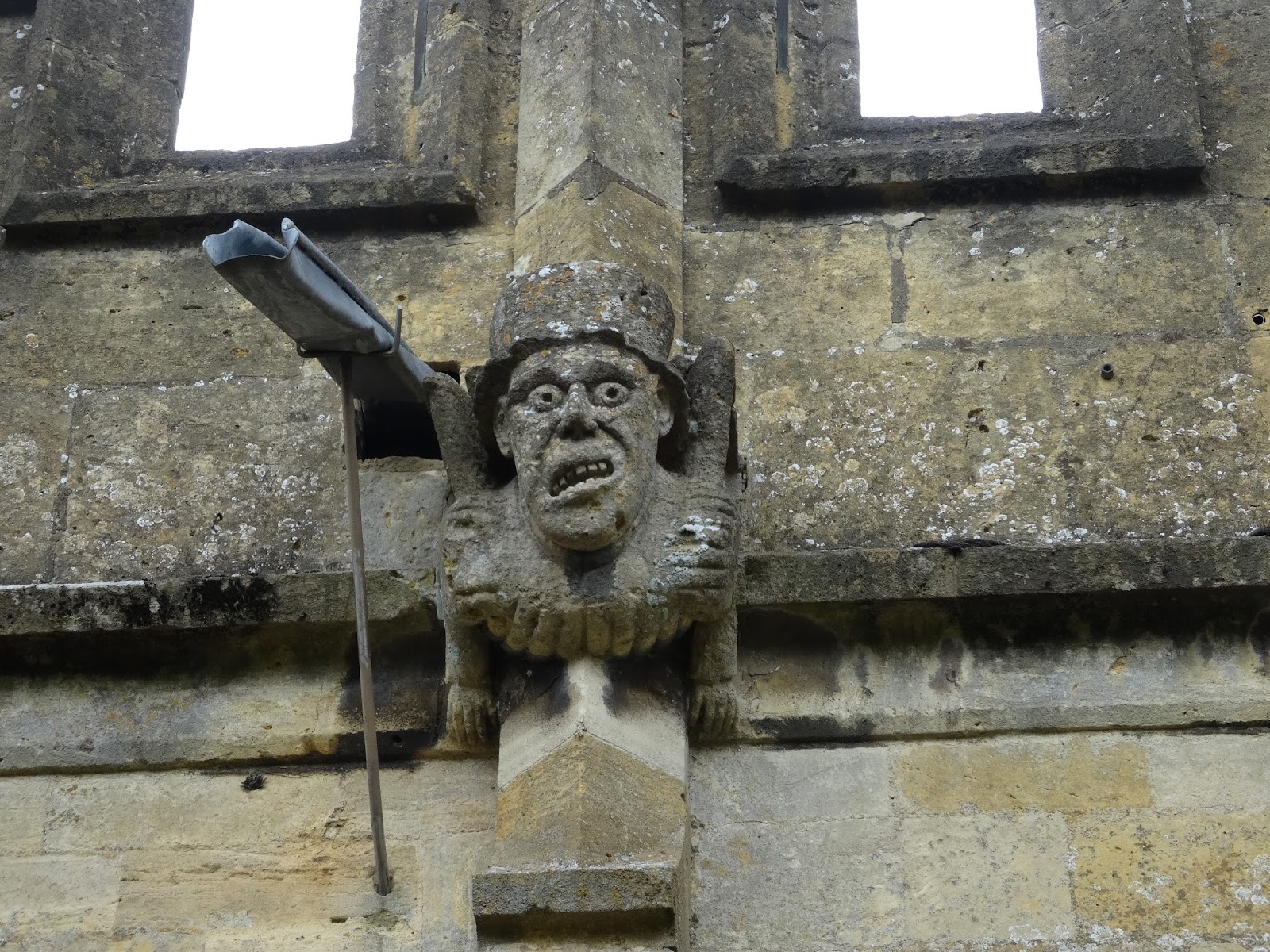
St Peter's has forty wonderful grotesques- I loved this one:) Grotesques are just carved figures, it's the gargoyles that were originally water spouts. Apparently this one was the inspiration for the Mad Hatter in Lewis Carroll's Alice in Wonderland. I wish we'd had time to look for all of them.


The base and shaft of the font date from 1654 and the lovely painted font cover is mid 18th century. The bowl is a replacement for the one that was destroyed during the Civil War but there is a discreet silence about whether the Royalists or the Roundheads were responsible - I know which I'd bet on:) Behind the font is one of two Saxon stone coffins, one is thought to be that of King Kenulf and the other of his son St Kenelm both of whom were buried in the nearby Abbey church. Kenulf or Coenwulf was King of Mercia from 796AD until his death in 821AD.


This 14th century altar cloth is made from pieces of vestments and it's thought that it was stitched together and the border embroidered by Catherine of Aragon the first wife of Henry VIII during a stay at nearby Sudeley Castle. Sudeley is another place on my list of places to go on my next visit to the Cotswolds. The curtains are kept closed to protect the fragile fabrics from the light, a guardian opens them when someone wants to look at the altar cloth.


Here we have a statue which represents King Kenulf who founded the Benedictine Abbey that once stood nearby. The statue isn't very old - 1872 to be exact. It was given to St Peter's by Mrs Emily Dent who paid for the restoration of the church in the 1870s.


A beautiful medieval carved oak screen which once separated the nave and the chancel but has now been moved to the west end of the church. Can you see the imp?


Here he is:) Look at the third panel from the left in the previous photo.


The church is full of wonderful old things - this is the medieval Alms Box. It had three locks and one key was kept by the vicar and the other two by the churchwardens. The box could only be opened when all three were present. The church and the town both deserved more time than we were able to give them and I would definitely like to go back - maybe next year.


Belas Knapp is quite close to Winchcombe but spotting the narrow lane where the path up Cleve Hill begins is not easy if you don't know what you're looking for. Fortunately a local lady gave us precise instructions before we left Winchcombe. It's quite a long steep climb up to Belas Knapp but there are some wonderful views on the way up.


Belas Knapp is an early neolithic long barrow and was constructed about 3600/3700BC . It's about 50 metres ( 164 feet) long and 4 metres (13 feet) high. I've borrowed an aerial photograph from English Heritage to give you a proper idea of what it  looks like.


The skeletons of five children and a young man were found behind the stones of this portal setting with its projecting horns which formed a forecourt for ceremonial use presumably when burials were taking place. It was also possibly used at certain times of the year for ceremonies connected with the ancestors who were very important to neolithic people. My theory not an official one!


The barrow has four burial chambers and the remains of at least 38 people were found during various excavations. Fourteen skeletons were in this chamber which is on the north eastern side of the mound.


One of the two chambers set into the north western side, the fourth is on the narrow south east side but there is very little to see of that one.


Belas Knapp is in a wonderful position with lovely views in every direction. The barrow itself is covered in wildflowers including lots of wild thyme, yarrow and scabious. This lovely butterfly is, I think, a Marbled White. We were lucky to have Belas Knapp entirely to ourselves so we were able to absorb the tranquil atmosphere undisturbed. We met one couple coming down as we climbed up to it and as we were going down two more people were on their way up but that was it.


Eventually we made our way slowly back down Cleve Hill and set off towards Painswick. But that is for next time.

Wednesday, August 26, 2015

Two Cotswold Villages


Many people who visit the Cotswolds head for the well known places such as Stow-on-the-Wold, Bourton-on-the-Water and Broadway -  all very nice in their way but much too crowded for us. Though I have to say that Broadway has the most wonderful delicatessen - we bought various delicious things there and had them as a picnic lunch later on:) However we soon moved on to the delightful villages of Upper and Lower Slaughter. Above is the 12th century church of St Peter in Upper Slaughter. It's a pity that the day was rather cloudy so the photo is rather dreary looking especially with the two yew trees at the front of the church. This is an entirely false impression as the church and the village are both very attractive. There are an awful lot of people buried in that churchyard, apparently it stands six feet higher than the church itself!


This is the lovely 14th century font made even nicer by the flower arrangement standing on the font cover.


The font stands below the Norman archway at the western end of the church which forms the entrance to the church tower.


A walk down the lane that runs by the side of the church brings you to the pretty little ford crossing the River Eye. This joins with another small river further down and eventually runs into the River Windrush at Bourton-on-the-Water. There is a small stone footbridge over the river as well. One thing you won't find in Upper Slaughter is a war memorial. It is one of only fourteen villages in England and Wales where every one of the soldiers who went to fight in the two World Wars returned safely, 25 in WW1 and 36 in WW2.


On the way to Lower Slaughter we passed this beautiful Elizabethan manor house - Upper Slaughter Manor..


The River Eye runs through Lower Slaughter as well and there are several of these stone slab bridges crossing it. It's a lovely village and although there were a few more visitors here than in Upper Slaughter it was still quiet and peaceful. The name Slaughter actually has nothing to do with killing anything - it derives from the Old English word 'sloughtre' which means a muddy place. The level of the river is so near the level of the road in both villages that I can well believe that it in past centuries it was very muddy indeed in winter. And probably in spring and autumn too!


I loved this tiny front garden, it makes the most of every bit of space and everything blends beautifully.


This 19th century mill with its restored water wheel was still working until 1958. The mill house now houses a tea room, small museum and gift shop. It took us about 30 seconds to decide it wasn't our kind of place:) The words 'tourist trap' spring to mind! We, of course, are not tourists but travellers:)

Wednesday, August 19, 2015

Ancestral Trail


I've been tracing my family history for many years and have known for a long time that my great grandmother was born in Evesham Workhouse  in 1851 and that her mother's family lived in Aldington which is a hamlet a couple of miles from Evesham. Since we were visiting the Cotswolds I wanted to visit the places that Amelia and her mother and grandparents would have been familiar with. Amelia was born in the Workhouse as her mother was unmarried and this is where single women often went to have their babies at this period in time. Amelia's mother was Robina Pugh who was born in 1828, she was baptized in Badsey Church which is in the photo above. Aldington was too small to have a church of its own so the people who lived there walked to Badsey, which was only a mile away, to be hatched, matched and despatched. Both Badsey and Aldington were poor rural communities until the late 19th century when market gardening brought prosperity to the area - too late for my ancestors who had all left by 1871.


The church was built in 1120 with additions in 1325 and 1450 and it then seems to have suffered 400 years of neglect until major restoration took place in 1885.This is the outside of the north wall with its blocked up Norman doorway which is the only remaining part of the original Norman church


 The churchyard seems to have suffered a similar fate, oddly until 1866 the churchyard belonged to the Lord of the Manor who obviously took very little interest in it. The Rev.Thomas Hunt, who was vicar from 1852 - 1887, wrote

 'Nettles are growing up everywhere. The sheep turned in and left all night plough up the turf from the newly made graves'.

This doesn't conjure up a particularly attractive vision of the place where Robina's 23 year old brother was buried in 1863! Things improved once the church bought the churchyard in 1866 however and it's now well kept. I don't know how old the yew tree is but I would guess that it might go back to medieval times. It's certainly on the list of ancient and veteran yew trees.


The 16th century Badsey Manor House. Originally there was a house for the ill and infirm monks of Evesham Abbey on this site but after the dissolution of the monasteries it was acquired by Sir Philip Hoby. In 1587 Richard Hoby rebuilt it in the Elizabethan style and it's thought that he incorporated some of the walls of the former sick house into the new manor house.


From Badsey we went on to Aldington. I have no way of knowing which of the cottages my 3xgt-grandparents lived in of course but it's very likely that it was one of these. There were only 19 houses in Aldington in 1841 and since the Manor House, the Mill, 2 farms and a house occupied by a solicitor are out of the equation it doesn't leave many to choose from.


The final place on the family history hunt was the little village of Childswickham now in Worcestershire but formerly in Gloucestershire. This was the birthplace of my 3xgt-grandmother Sarah. I can't give her a surname because I now need to visit Worcester Record Office to search the parish registers for her marriage to John Pugh and for various baptisms and burials. Neither John nor Sarah were buried in Badsey and my guess is that both ended up in the Workhouse and are buried somewhere in Evesham. They weren't married in Badsey either so Childswickham is a good bet there or failing that Evesham. St Mary's is another old church with Norman origins that had to be pretty much rebuilt in the 1870s. The list of vicars goes back to 1283 though.


Sarah was born around 1797 well before the church was restored but this is the 17th century font where she would have been baptized.


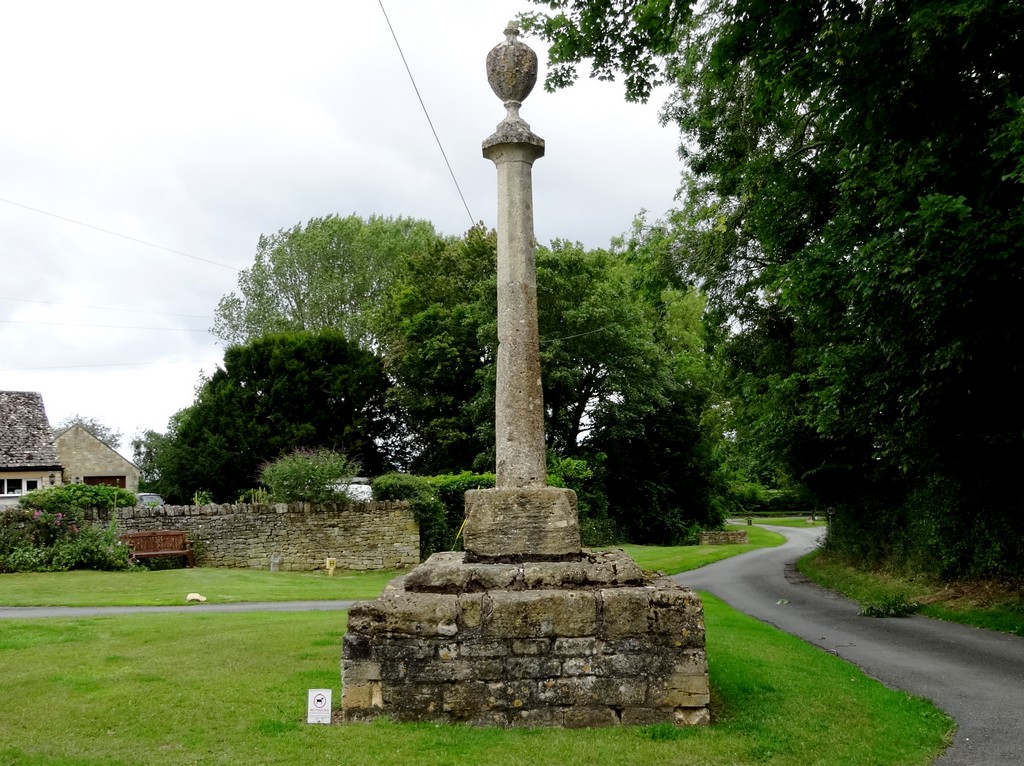
Sarah would have known the 15th century village cross which stands at the old village centre 300 yards from the church.It has its original medieval base but the cross was destroyed by the Puritans (they have a lot to answer for!)and was replaced in the 18th century by a classical urn.


As with many workhouses the one at Evesham eventually became the local hospital but the buildings that existed in 1851 are now demolished and lie under the car park. Robina and her father John, who was also born in Evesham,would have known this lovely old 14th century building though. It is the Almonry which once housed the Almoner of the Benedictine Abbey which was founded in the 8th century. The Almoner was responsible for distributing alms to the poor.


The stocks were originally in the town hall jailhouse but were moved here in the 1920s. The stocks were a form of punishment involving public humiliation, they would be used to punish people who were drunk or tradesmen who had tried to cheat customers and other minor offences. The criminal had to sit on a low bench with their feet locked between the two wooden boards for several hours and sometimes longer. People passing by would jeer at them and often throw rotten fruit or eggs at them.  In severe weather the exposure sometimes resulted in death even though this wasn't intended.


This ruined archway once led to the cloisters of Evesham Abbey. Although it was demolished when Henry VIII ordered the dissolution of the monasteries there is still quite a lot of stone work visible on the ground this is the only remaining section of walling though. It's possible that Lady Godiva was buried here in the Church of the Blessed Trinity which  is no longer there having presumably been demolished along with the rest of the Abbey. This church was founded by Lady Godiva and her husband Earl Leofric.


Closer inspection of the archway revealed these weatherworn carved stone figures. They must have been rather splendid in their heyday.


I would really like to visit Evesham again and spend more time there,it's a very historic place and has a lot to see including this wonderful 15th century timber framed house which is now the local Nat West Bank. Originally it was a Tudor merchant's house.


All the Evesham photos were taken on the first evening as we had a quick look round on our way to dinner at the Royal Oak. The frontage is a modern sham but the building itself is 16th century and so is genuinely old and is Grade 2 listed. Apparently it's haunted too! The key thing though is that the food is really excellent, we only intended to eat there on the first night but we enjoyed it so much that we returned on the other two nights as well.