Therefore all seasons shall be sweet to thee,
Whether summer clothe the general earth
With greeness, or the redbreast sit and sing
Betwixt the tufts of snow on the bare branch
Of mossy apple-tree, while the nigh thatch
Smokes in the sun-thaw; whether the eave-drops fall
Heard only in the trances of the blast,
Or if the secret ministry of frost
Shall hang them up in silent icicles,
Quietly shining to the quiet Moon.


Friday, August 14, 2015

Shakespeare and Stratford - Act Two


We had much better weather for our second visit to Stratford and arrived early which gave me chance to take a photograph of the house on Henley Street where William Shakespeare was born without hordes of tourists in front of it. Shakespeare lived here with his parents until he married Anne Hathaway at the age of 18 and the couple then spent the first five years of their married life here.


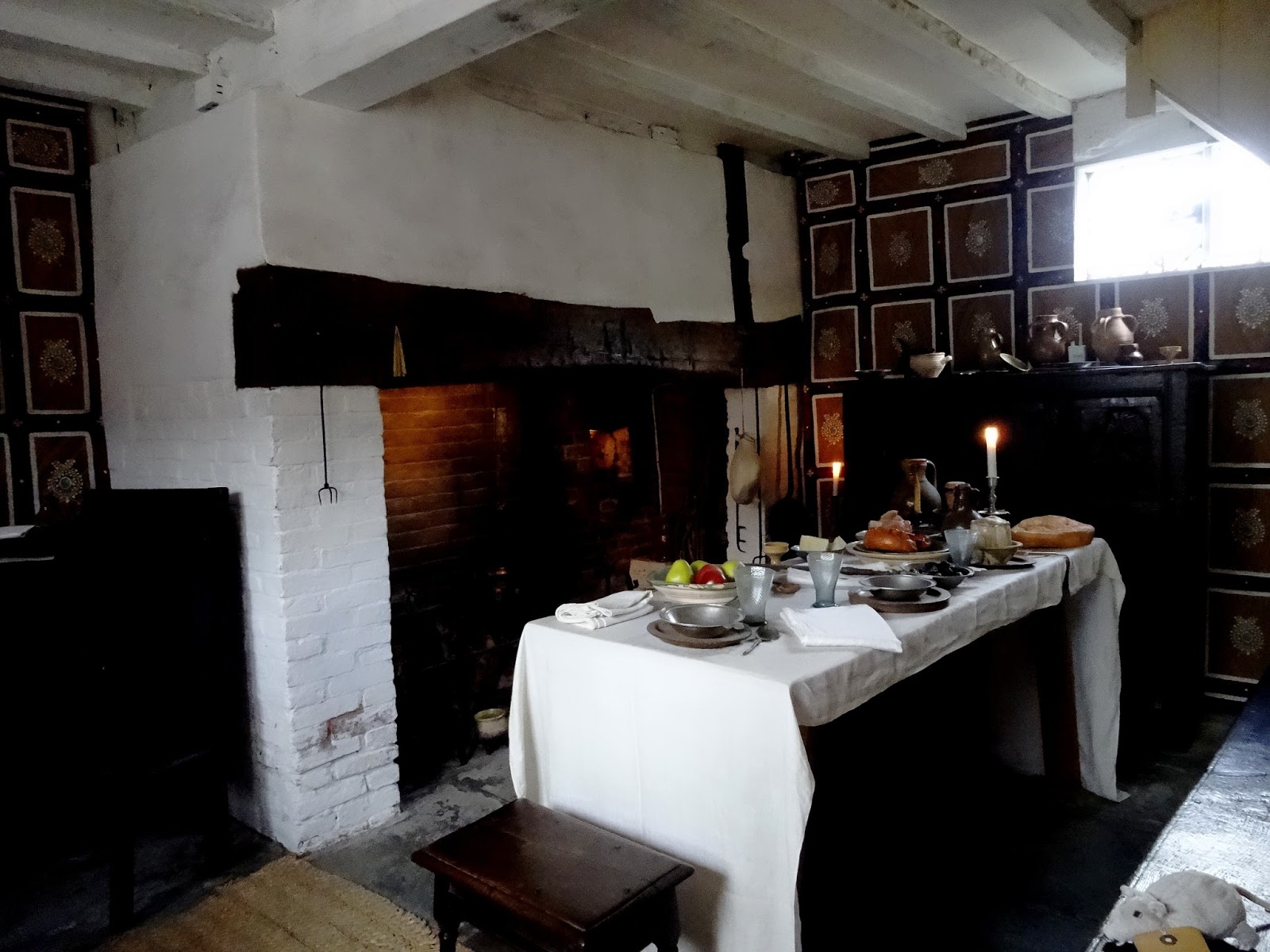
Taking photographs was really difficult as the house was absolutely packed so there was neither time nor space especially as the rooms were quite small to begin with. There didn't seem to be any individual guide books to the houses only one book which covered them all so I don't really know what this room is but I'm assuming it was the kitchen.


William's father, John Shakespeare, was a glover by trade and the house was also his workplace. I found this display of the glovers tools and the various styles of gloves really interesting. Notice the rabbit fur which was used to line gloves for cold winter weather.


I'm afraid that we didn't stay very long in Shakespeare's Birthplace, it was so crowded that there wasn't a great deal of pleasure in it. Instead we decided to walk along the River Avon to Holy Trinity Church where Shakespeare was baptized, married and buried. The day was pleasant and warm and once we got about 200 yards along the riverbank there were very few people which is amazing since the part near the town centre was packed.


Holy Trinity is a very ancient church, there was a wooden Saxon church on this site as early as the 8th century. The Normans rebuilt the Saxon church in stone but the core of  the present building dates back to 1210 when the Norman church was rebuilt. Holy Trinity has other interesting features apart from Shakespeare's grave. The photo above is of the Clopton Chapel which is the finest Renaissance tomb in England, here lie Sir George Carew and his wife Joyce Clopton. Sir George was Master in Ordnance to King James I hence the canon on the lower part of the monument The Chapel is actually named after Sir Hugh Clopton a native of Stratford who became Lord Mayor of London in 1491/92. He wanted to be buried in what was then the Lady Chapel where he had built an ornate tomb for himself. Unfortunately he was in London when he died so was buried there and it is later members of the family who are buried in Holy Trinity. As with several of these photos you will see more detail if you click on them and enlarge them.


The church has a wonderful set of twenty eight 15th century misericords.  They show a variety of real and mythical animals and scenes from daily life which, judging from some of the carvings, must have been decidedly interesting!


 Shakespeare died on St George's Day - April 23rd - 1616. This funerary monument was erected on the north wall of the chancel within a few years of his death and is said to be a good likeness.


The graves of Shakespeare and his wife Anne lie side by side in the chancel of Holy Trinity. Following the dissolution of the monasteries by Henry VIII the tithe income privileges of the church were sold off. The duty of employing a priest and looking after the chancel went with the privileges. In 1605 Shakespeare purchased a share in these privileges for £440 . It was this, and not his ability as a poet and playwright, which gave him the right of burial in the chancel. The curse which is inscribed on the grave was to dissuade anyone from digging up his bones and putting them in the charnel house - a frequent occurence in earlier times although I'd be surprised if the bones of those buried in the chancel of the church itself would be disturbed.


Very close to Holy Trinity stands Hall's Croft which was definitely our favourite of the houses we visited. It belonged to Dr John Hall who married Shakespeare's daughter Susanna in 1607. It's a really lovely house. Dr John Hall was a physician and was skilled in the use of herbs


This was my favourite room in the house - the parlour. Notice the beautiful carved Elizabethan child's high chair on the right.


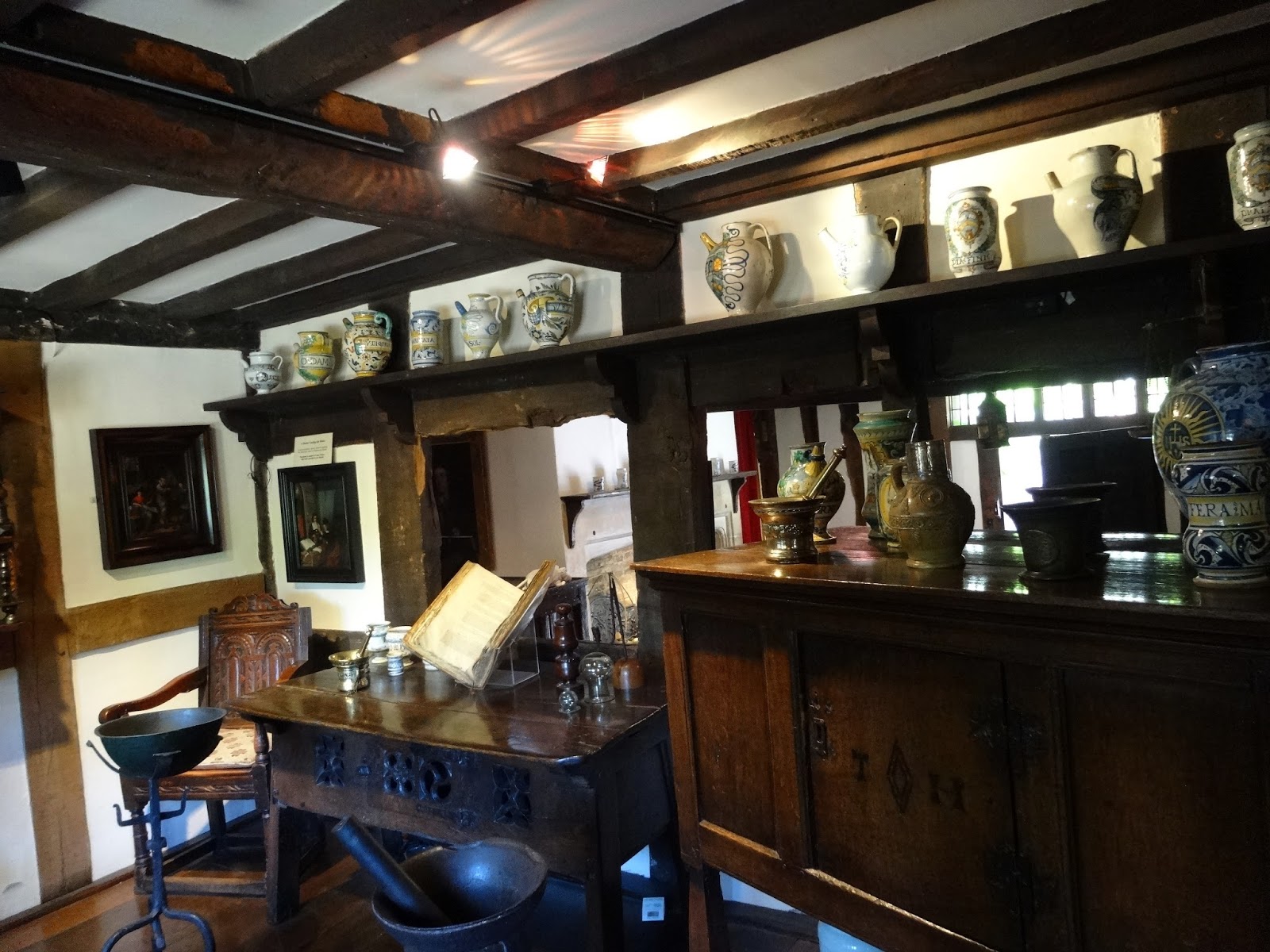
There's an interesting exhibition of the equipment used by an Elizabethan apothecary - the jars would have held various liquid preparations, dry ingredients, pills and lozenges and so on. Some of them are really attractive.


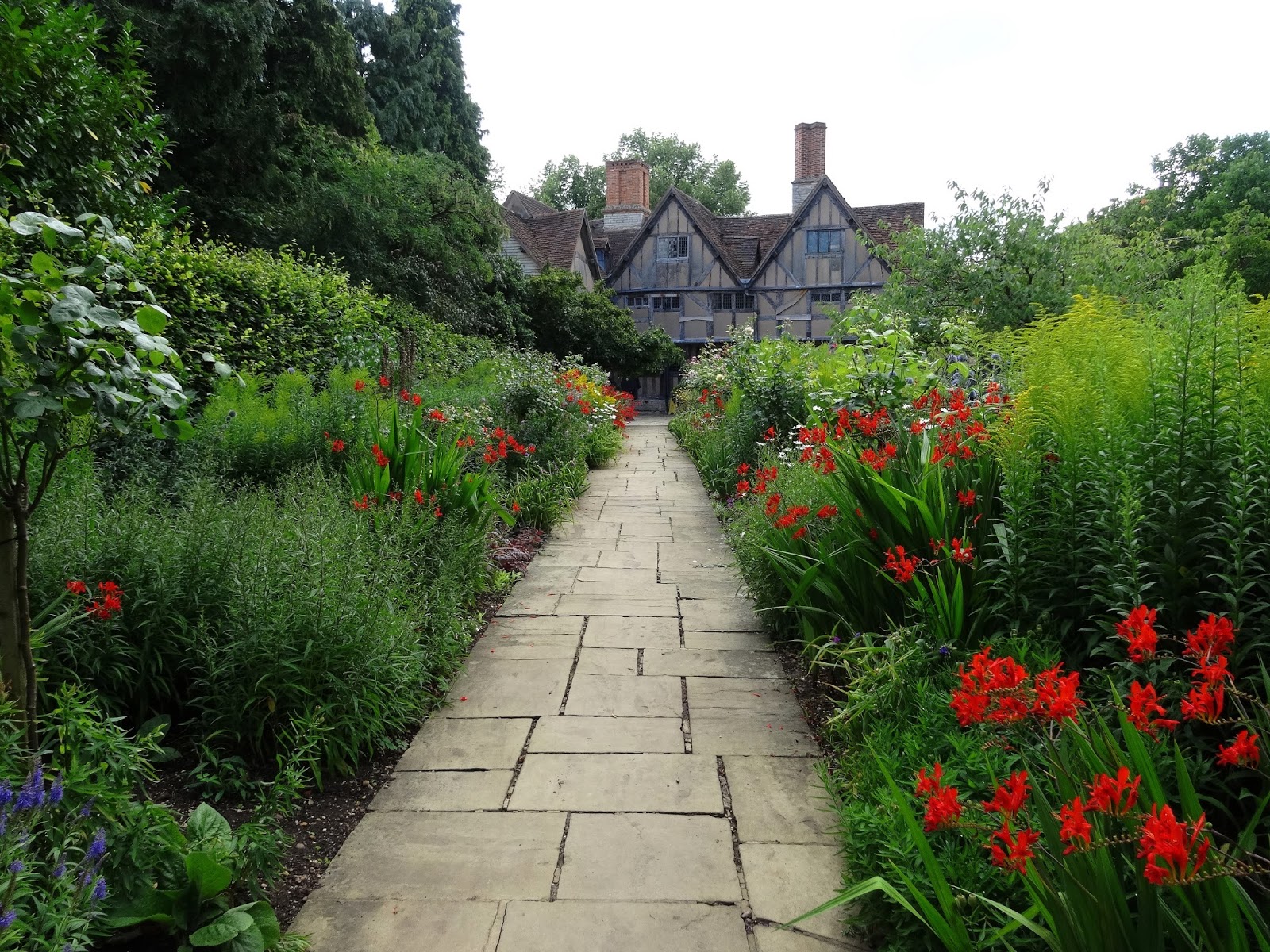
There's a lovely garden at the back of Hall's Croft which I suspect would once have been where Dr Hall grew the medicinal herbs for his practice. We were lucky in having the garden virtually to ourselves although several people came out just as we were leaving. There were surprisingly few people in both the house and garden especially compared with the crowds in the Birthplace on Henley St.

We passed these wonderful old almshouses on our way back to the town centre, The plaque in the photo below gives their history.


A quick visit to Marks and Spencer's provided us with a picnic lunch which we ate sitting in the sunshine by the river before setting off on the journey home.

Monday, August 10, 2015

Shakespeare and Stratford - Act One


My daughter and I recently spent a few days in the Cotswolds and this has enabled me to fulfil a long held ambition to visit Anne Hathaway's Cottage and some of the other places associated with William Shakespeare. On the way down we went to Anne Hathaway's Cottage and Mary Ardern's Farm and on the way back we stopped in Stratford itself and visited the Shakespeare Birthplace, Hall's Croft and Holy Trinity Church.


Anne Hathaway was the daughter of Richard Hathaway a well to do yeoman farmer who lived in the village of Shottery just outside Stratford.The right hand part is the original farmhouse built around 1460. In the early 17th century Anne's brother Bartholomew Hathaway added the taller lefthand section. The Hathaways were close friends of the Shakespeare family which included their son William. In August 1582 there was a particularly good harvest and it would seem that 26 year old Anne and 18 year old William joined in the harvest celebrations a little too enthusiastically. On November 27th 1582 there was a rather hurried wedding at Holy Trinity Church closely followed by the baptism of their daughter Susanna on May 26th 1583!


I love the beautiful stone flagged floor and the drop leaf table in this photo. The vast hearth includes a bread oven with a wooden peel for getting the loaves into and out of the oven.


Shakespeare's Courting Chair is traditionally thought to have belonged to William Shakespeare and is said to have been given to the Hathaway family by his granddaughter Lady Elizabeth Barnard. It's an early 16th century chair so is certainly of the correct period but there does seem to be a degree of doubt about whether it really belonged to Shakespeare.


My favourite rooms in old houses are almost always the kitchens and pantries. I would give a good deal to own those wonderful pancheons and the lovely wooden butter churn.

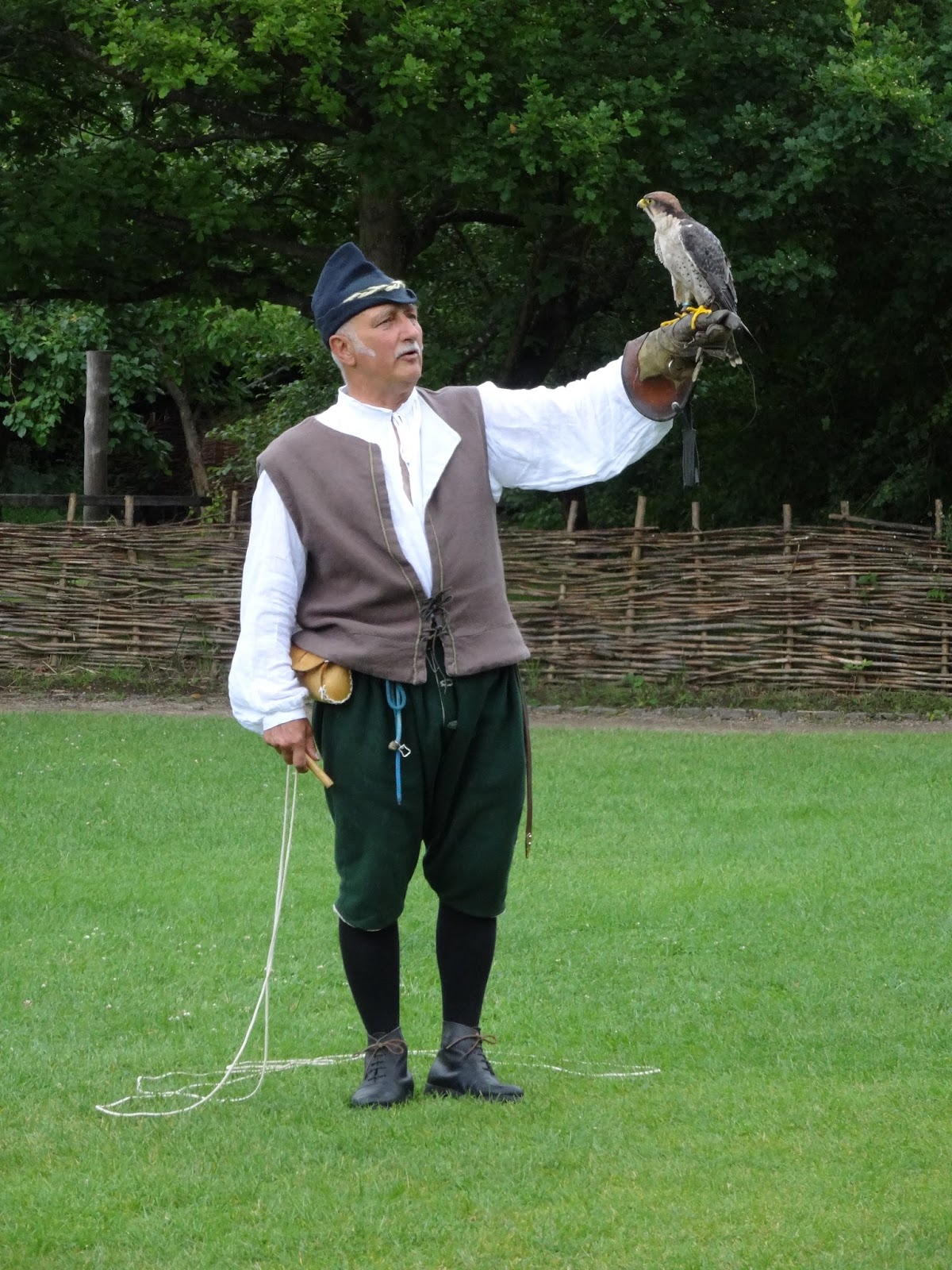
Our next stop was Mary Arden's farm at Wilmcote, the home of William Shakespeare's mother. Wilmcote is the area traditionally known as the Forest of Arden famous as the setting for the play 'As You Like It' although even in Shakespeare's time the forest was long gone. Here we have the shepherd on the right and the falconer on the left passing the time of day. Both were charming and interesting to talk to, the sheep is a Cotswold which an old breed of sheep that would have been farmed in this area in Shakespeare's time.


My daughter isn't a fan of looking round historic houses but she does like animals so was much more enthusiastic about Mary Arden's farm. Here we have an English Longhorn and her calf.


My daughter's new friend:) He's a Mangalitsa, a rare breed long haired pig originally from Austria/Hungary and similar to the wild boar that would have been around in the Tudor era.


As we walked back towards the farmhouse we saw the falconer at work so we stopped to watch. He's flying a beautiful Lanner falcon. In Tudor times falconry was a very popular sport with both royalty and the aristocracy.


Having flown in a very spectacular manner and having - eventually! - returned the falcon has gained his reward and is guarding it with wings spread. I love this photograph. Later we discovered that the falconer also had ferrets and we were allowed to hold them. They are incredibly wriggly and you need to keep a firm grip on them without hurting them or they'd be gone. I've always liked ferrets.


This is the farmhouse which was Mary Arden's childhood home although this has only been discovered fairly recently. Previously the house now known as Palmer's Farm was thought to be Mary Arden's house. Fortunately the Shakespeare Birthplace Trust owned both properties and this farmhouse is now used more as a museum. There's a lovely garden outside filled with borage, St John's wort, lemon balm and other herbs and cottage garden flowers which Shakespeare would have known well. He mentions flowers often in his plays -

"Here's flowers for you;
Hot lavender, mints, savory, marjoram."

from The Winter's Tale. Not that I'm an expert on Shakespeare's plays ! I have a lovely and very useful book called Shakespeare's Flowers which is full of quotes.


Palmer's Farm is very close to the Arden's farm and belonged to Adam Palmer who was a close friend of William's parents and grandparents. This house is furnished and is used as a living history setting. It's a wonderful building with walls that bend and bow out but in spite of this it has stood here since the 16th century.


This is the best room in the house which was not only a place to eat and relax but was also the master bedroom - much warmer down here where there would be a fire to warm the room.


Rather less luxurious upstairs where the children slept!


The small dairy - cheese was being made here and the smell was really strong.


As with many very old houses there is a passage that runs right through from front to back. The kitchens etc are to the left and the family's living quarters are to the right. I suspect that originally the arrangement would have been animals living on the left and people on the right! This was usually the case with medieval longhouses but I don't know whether Palmer's Farm really did start out this way.


This is the back of Palmer's Farm showing the woodstack and the farmyard. I should finish here really but I can't resist adding.....


the Tamworth pigs.....


the goats - there were three of them but this one was definitely in charge!.....

and last but not least Ellie the horse:)

Friday, July 10, 2015

Well Dressing


This week is our village Well Dressing and above is the well dressed by the local Guides. They chose to celebrate the 150th anniversary of the publication of Lewis Carroll's book 'Alice in Wonderland'. The characters are based on the original illustrations by John Tenniel.


The main well dressing commemorates the granting of Magna Carta at Runnymede on June 15th 1215 where it was sealed - not signed - by King John and witnessed by twenty five barons. Magna Carta or The Great Charter was drawn up after a rebellion by the barons because the king had demanded heavy taxes to finance his unsuccesful wars in France. It enshrined the rights, privileges and liberties of the nobles and clergy and limited the power of the Crown.

Magna Carta was written in medieval Latin on parchment made from dried sheepskin and the words were often abbreviated to save space on the parchment. Many copies were made and sent out to bishops and sheriffs all over England. Only four of these copies survive, two in the British Library, one in Lincoln and one in Salisbury. I've seen the one in Salisbury Cathedral and it's much smaller than I'd imagined. It's an iconic document and inspired the American Declaration of Independence of 1775 and the 1948 UN Charter for Human Rights. Only three of the original clauses in Magna Carta are still law. One defends the freedom and rights of the English church, another confirms the liberties and customs of London and other towns, and the third paved the way for trial by jury by stating that no man could be arrested, imprisoned or have their possessions taken away except by “the lawful judgement of his equals or by the law of the land”

This is the seal of King John who was the younger brother of Richard the Lionheart. John succeeded to the throne of England after Richard's death in 1199. John is also of course the villain, along with the Sheriff of Nottingham, in all the stories of Robin Hood. So there we are - that's the end of today's history lesson:)

Friday, July 03, 2015

Madrid Again

On Sunday morning we took the train back from Granada to Madrid arriving early in the afternoon. The rest of the day was spent eating, drinking and relaxing. Our flight home was late on Monday afternoon so we checked out of our hotel early but we were able to leave our luggage there until mid afternoon when a taxi would collect us and take us to the airport. We decided to walk up to Retiro Park again and spend some time exploring the areas we hadn't yet seen. The photograph of the Royal Palace was taken at 7.50am on our way to get breakfast.


Chocolate and churros for the last time:) Just as well with all those calories!


This is the Puerta del Sol - the very heart of Madrid. The Puerta del Sol means Gate of the Sun and it was where one of the gates in the city wall that surrounded Madrid in the 15th century stood. The statue of King Charles III and the Tio Pepe sign are famous landmarks. Charles III reigned from 1759 to 1788 and was generally a good egg who tried to do his best for his country.


I love this bronze statue of the Bear and the Madrone Tree which have been the symbols of the city of Madrid since the 13th century.


The sculptured shapes of these trees really appeals to me in this setting though I wouldn't want them in my garden. They need a lot of space around them to be seen at their best.


This is the formal part of the Retiro with lots of colourful bedding plants and specimen trees. The building in the centre right at the far end is the Prado Museum.The park covers about 320 acres and in the 17th century when a royal palace stood on the site only the Royal Family were allowed to use it.It was opened to the public in the 18th century.


The boating lake is popular with both tourists and local people. The enormous Alfonso XII monument dates from 1922.


Retiro is filled with statues, monuments and many lovely fountains both large and small.


This is the Crystal Palace which stands by another lake in the Park. It was built in 1887 and was originally used to house exotic plants but these days it houses temporary exhibition.


Aren't these trees fabulous? I wish I knew what they are.


We walked all round the lake enjoying the autumn colours and the ducks, there were turtles sunning themselves as well. On the far side there was this little grotto and waterfall.

If you walk further round you can look out through the grotto and across the lake.


As we walked back through the Paseo del Prado we saw these figures in period costume leaning over the balconies gossiping and watching the crowds go by. Rather fun:)


Back in the Plaza de San Miguel we had a late lunch at our favourite little eating place - The Secret Garden. We discovered it on our first day in Madrid, the food is excellent and it's right next to the Mercado San Miguel handy for last minute purchases of chocolates:) We really enjoyed our visit to Spain and I would love to go back again one day especially to Andalucia.